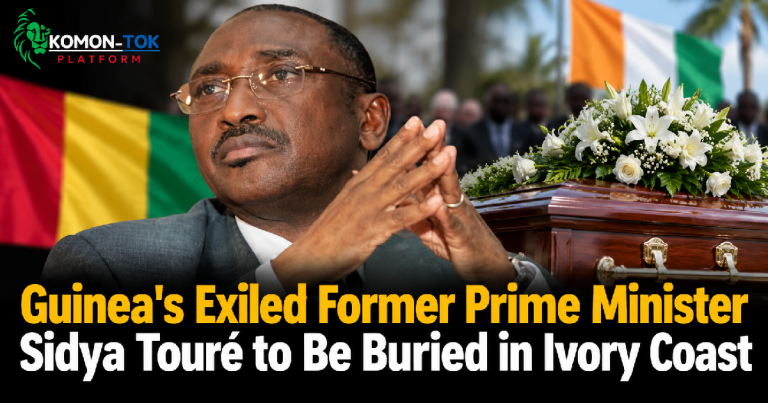
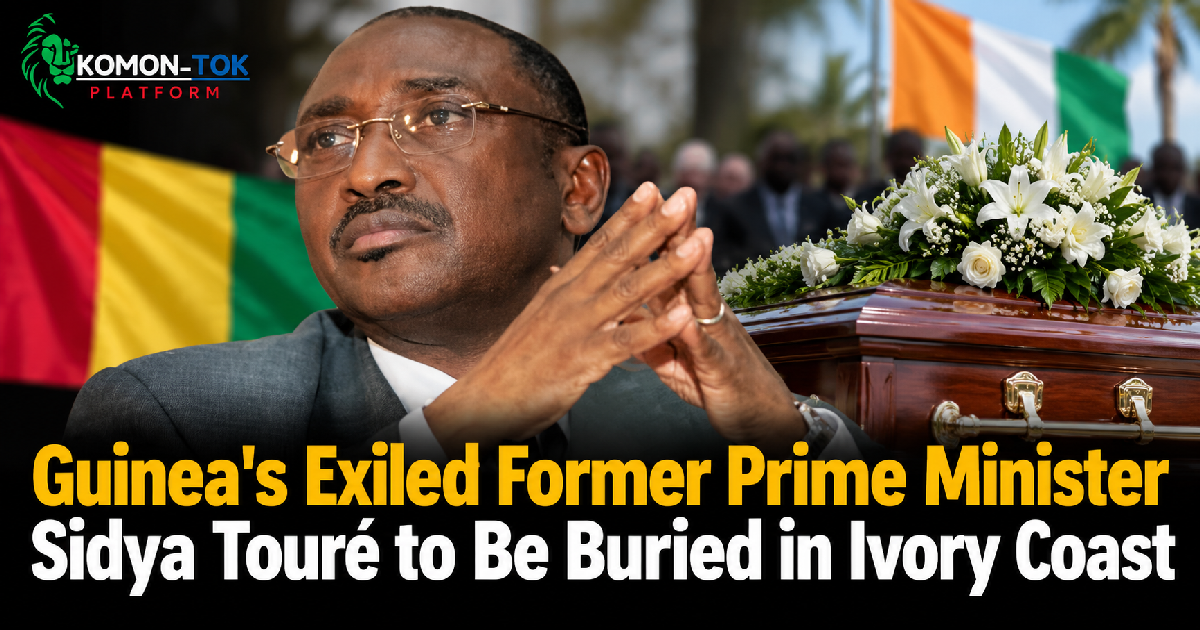
Even in death, former Guinean Prime Minister Sidya Touré will not return home.
Touré’s family has confirmed he will be buried in Abidjan, Ivory Coast, rather than in Conakry, a decision his party says reflects the humiliation he suffered under Guinea’s military authorities.
Touré, 81, died on Friday, September 26 in Paris at the American Hospital of Paris, where he had been receiving treatment for two weeks after falling ill in Abidjan. RFI and Africanews first reported the burial plans.
It is a symbolic end for one of Guinea’s most enduring political figures,a man who once led the government but spent his final years in exile.
From technocrat to opposition leader
Born in 1945 in Ivory Coast, Touré made his early career in the Ivorian financial administration before returning to Guinea.
He was appointed Prime Minister in July 1996 by longtime President Lansana Conté, who ruled from 1984 to 2008. His tenure until March 1999 was remembered as that of a disciplined technocrat: he overhauled public finances, restored ties with the IMF and World Bank, improved Conakry’s water and electricity grids, and pushed anti-corruption measures. He left after policy disputes with military elites.
In 2000, he took over the Union of Republican Forces (UFR) and built it into one of Guinea’s major opposition parties, campaigning on economic reform and governance. He contested the landmark 2010 presidential election, finishing third with over 13% of the vote, and ran again in 2015.
Between 2016 and 2018, he briefly served as High Representative of the Head of State under President Alpha Condé before resigning in protest over Condé’s push to change the constitution for a third term.
Exile after the 2021 coup
Touré has lived outside Guinea since early 2022. After Colonel Mamadi Doumbouya seized power in September 2021, relations deteriorated quickly. In February 2022, security forces evicted Touré from his private residence in the La Minière neighbourhood of Conakry as part of a junta-led recovery of alleged state assets.
He settled in Abidjan and continued to criticize what he called the junta’s authoritarian drift.
In March 2026, the Doumbouya administration dissolved 40 political parties, including Touré’s UFR, as well as the two other main opposition parties, Cellou Dalein Diallo’s UFDG and Condé’s RPG. Doumbouya was then elected president in December 2025 in a vote held without the main opposition.
For Touré’s party, a burial in Guinea was therefore “inconceivable” because of the “humiliations” he suffered “at the hands of the Guinean authorities.”
A wider exile
His burial in Abidjan places him in a growing list of Guinean leaders who died or remain outside the country. UFDG leader Cellou Dalein Diallo, who called Touré “a friend and companion in the struggle,” also remains in exile, saying political and judicial conditions prevent his return, a claim the junta denies.
Guinea’s Prime Minister Bah Oury paid tribute to Touré as a “pragmatic reformer” whose modernization efforts left an indelible mark.
Touré’s body was expected to arrive in Abidjan on Friday, October 3, with funeral arrangements to follow.