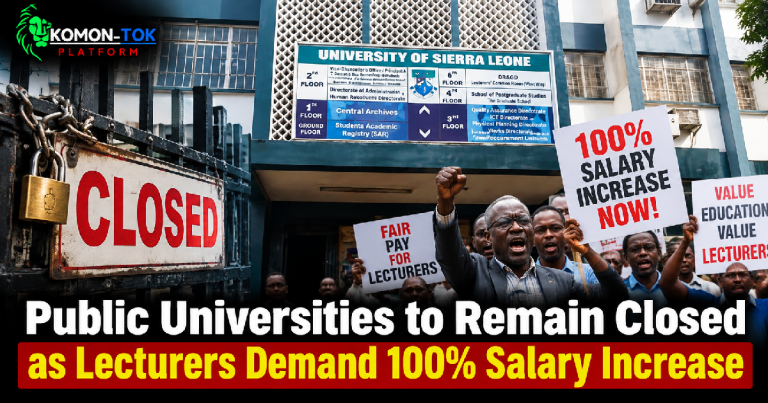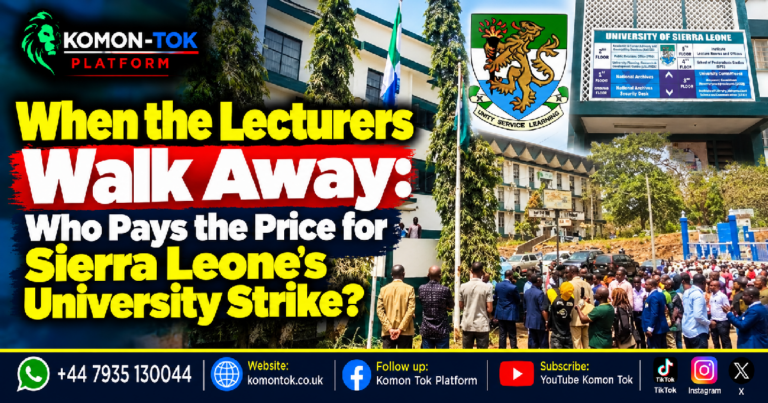
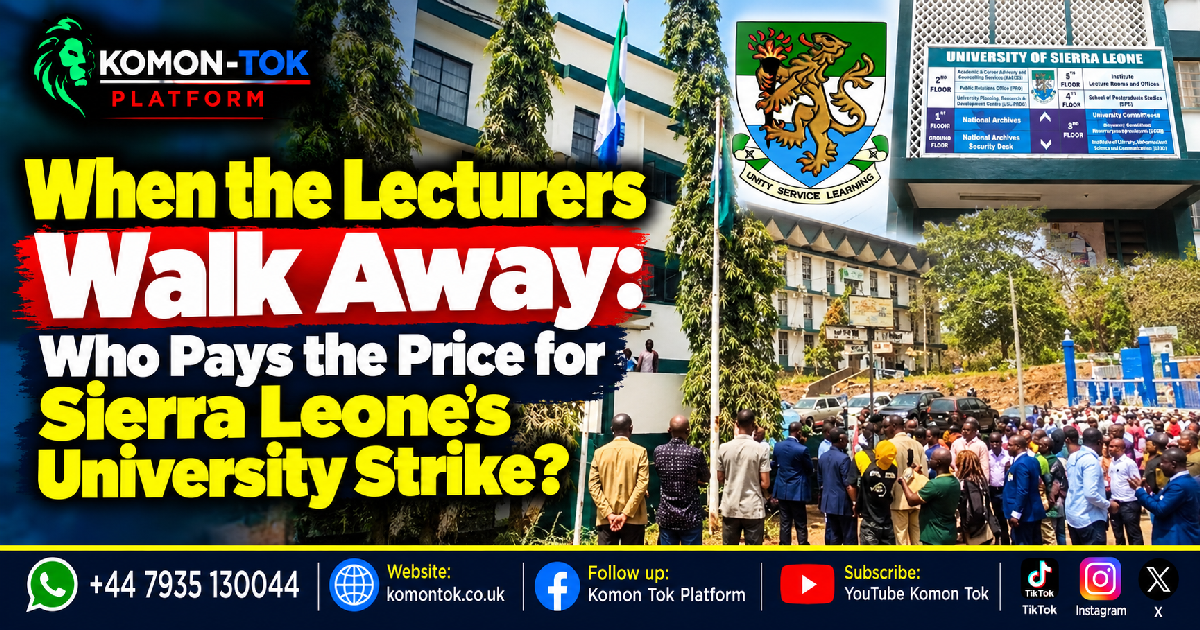
It is quiet on campuses where there should be noise. At Fourah Bay College, IPAM, COMAHS, Milton Margai Technical University, Ernest Bai Koroma University and Njala, lecture halls are locked, notice boards are empty, and final year students are counting weeks they cannot afford to lose.
The strike by the Union of Academic Staff Associations, UASA, has entered its second month. What began with a 21-day notice on 13 August 2026 turned into a full withdrawal of services at midnight on 16 September 2026. Two demands have held the line since then: a 100 percent salary increase and the full implementation of the reviewed 2026-2028 Harmonised Conditions of Service.
For students, it is not a labour dispute. It is a life plan put on hold.
In Sierra Leone, a university degree is a family project. Parents sell, borrow, and farm to pay fees. Students hustle okada, teaching and small business to pay for hostel and handouts. When lectures stop, rent does not stop. Feeding does not stop. And for final year students, job applications, scholarships and National Service do not wait.
How did we get here? UASA says this did not happen overnight. For almost three years, it has been engaging the Ministry of Technical and Higher Education, Ministry of Finance, the Tertiary Education Commission, the Conference of Vice Chancellors and Principals, the Office of the Chief Minister and lately, the Wages and Compensation Commission.
Government tells a different story. According to the Minister, Dr. Haja Ramatulai Wurie, lecturers already received a 75 percent increase in 2021, implemented in three instalments and compounded to about 87 percent, plus another 15 percent from April 2025. Government says it now pays about 83 percent of staff salaries and leave allowances in public tertiary institutions and pays on time.
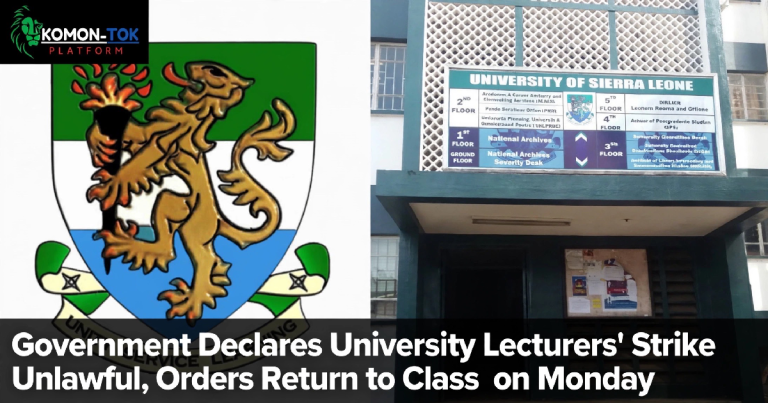
That is why on 9 October, MTHE declared the strike unlawful. The Ministry cited the Industrial Relations and Trade Union Act, 2024 — Section 63(3) which bars strike action while negotiations are ongoing, and Section 63(4) which requires a bargaining certificate. Government argues UASA is registered as a corporate entity with the National Investment Board but does not hold a bargaining certificate, and that the Universities Act of 2021 recognises individual Academic Staff Associations, not UASA as a national union.
UASA disagrees and has stayed its ground. A meeting of presidents and secretaries of its seven constituent associations on 29 September at EBKUST, Port Loko, resolved to continue the action.
A stakeholders’ meeting on 16 October ended without a firm commitment on the 100 percent demand, though a phased proposal — 40% in November 2026, 30% in May 2027 and 30% in September 2027 — was reported in the local press.
The most recent meeting, 23 October at COMAHS, brought together Finance Directors, registrars and MTHE officials, but the Ministry of Finance was absent and, according to UASA’s statement on 24 October, “no offer has been presented” on the salary increment.
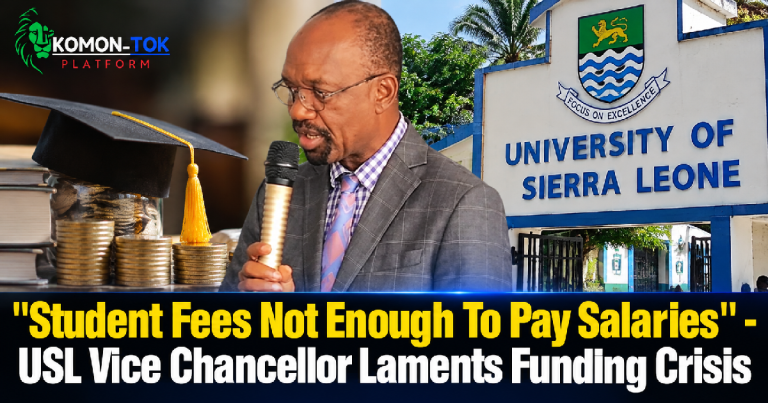
The missing context in the press releases is the market. Since fuel moved to NLe40 per litre for petrol and NLe45 for diesel, transport to campus alone now swallows a large part of a lecturer’s monthly take-home. Food prices, rent and school fees have all followed. Lecturers are not asking for luxury, they say, but for a salary that allows them to teach, supervise and research without doing two other jobs to survive.
But students are asking a simpler question: for how long will they be the collateral?
Repeated strikes do more than shift academic calendars. They delay graduation, weaken Sierra Leone’s human capital pipeline, and erode confidence in public universities at a time when President Bio’s Human Capital Development agenda needs those universities to deliver teachers, nurses, engineers and administrators.
What is the way forward? Three things must happen quickly.
First, government must put a written, costed position on the table. If 100 percent at once is impossible, say what is possible and whether a phased implementation can work.
Second, UASA must stay at the table with a clear mandate to negotiate. A compromise properly documented and monitored is better than a perfect demand never met.
Third, we need a return-to-work framework that lets students return to class while talks continue, and a transparent monitoring mechanism so we do not return here in 2027.
Students did not create this dispute. They should not continue to pay for it. The lecture halls must open again, and when they do, the agreement that opens them must be one both sides intend to keep.