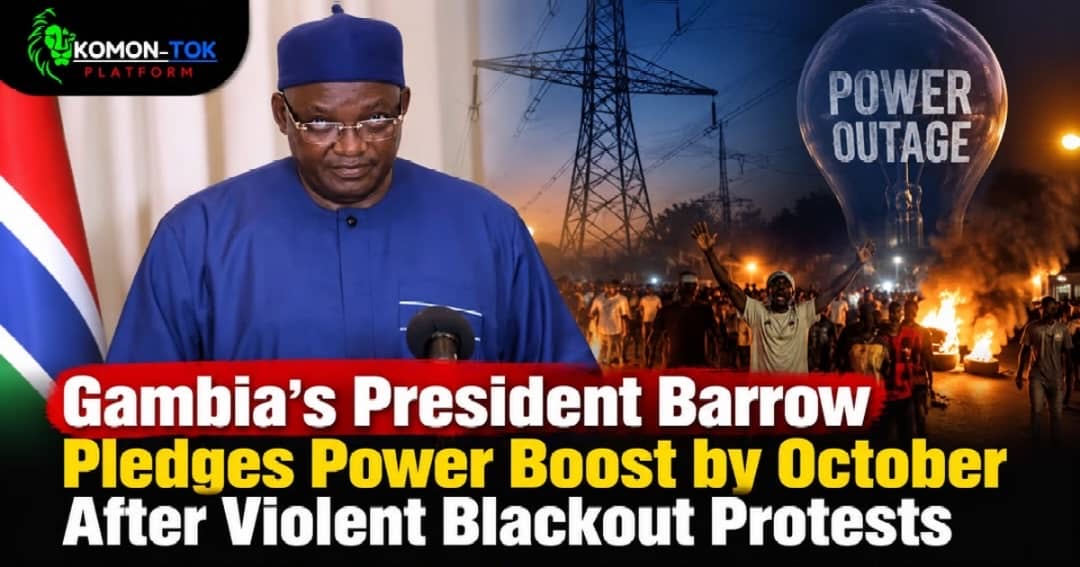
Gambia’s President, Adama Barrow has pledged to improve electricity supplies by the end of October after acknowledging widespread frustration over prolonged power cuts, following violent protests in the capital and surrounding areas.
In a televised national address on Tuesday evening, Barrow described the hardships facing households, saying fans have stopped working, children study in the dark, food spoils, and the heat is unbearable day and night.
He called the outages a “national security issue” and an emergency while admitting shortcomings in government planning, generation, and maintenance.
The president said The Gambia is not alone, pointing to similar challenges reported by the West African Power Pool across parts of the region.
He appealed for patience and restraint, particularly out of consideration for the sick, elderly and children, and stressed that his administration would not make undeliverable promises.
Government engineers and officials “will not rest” until power is restored to homes, he said.
Barrow announced concrete steps: a new 24-megawatt generating unit is in the final stages of installation at the Brikama power station and is due to be commissioned by the end of October 2026. A contract has also been awarded for a 50-megawatt solar plant in Soma, with mobilisation under way. He committed that the overall electricity situation would improve by then.
The remarks came after overnight protests on Monday into Tuesday in Banjul and nearby cities. Demonstrators burned tyres, erected barricades and chanted for Barrow to resign over blackouts that residents said sometimes lasted up to 48 hours during the hot season. Police used tear gas to disperse crowds, including near the president’s residence and the headquarters of the National Water and Electricity Company (NAWEC).
The rolling outages have persisted since June, driven by a surge in demand from high temperatures, technical problems, reduced power imports through the OMVG regional interconnection (linking The Gambia with Senegal, Guinea and others), and maintenance shortfalls at domestic plants. NAWEC has also cited climate-related pressures and broader supply-chain disruptions. Peak demand has outstripped available capacity, which relies heavily on imports alongside limited local generation.
The crisis adds political pressure on Barrow ahead of a presidential election expected in December, in which he is seeking a third term. Earlier in the year the government had claimed temporary stabilisation after import improvements, but problems have recurred.
Barrow urged citizens not to damage public infrastructure in anger, warning that such acts would only worsen disruptions and divert resources to repairs.