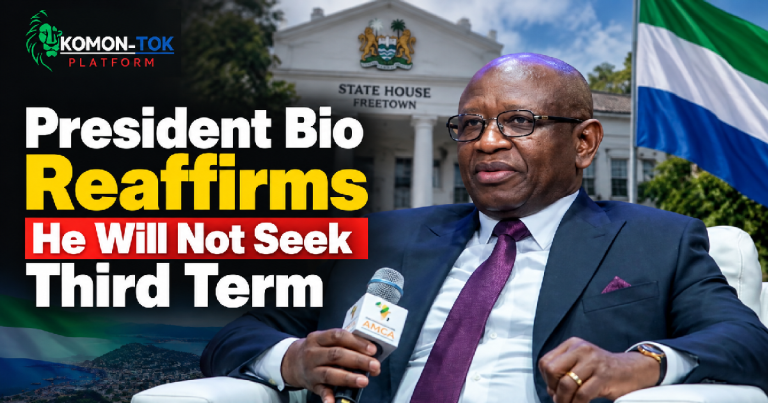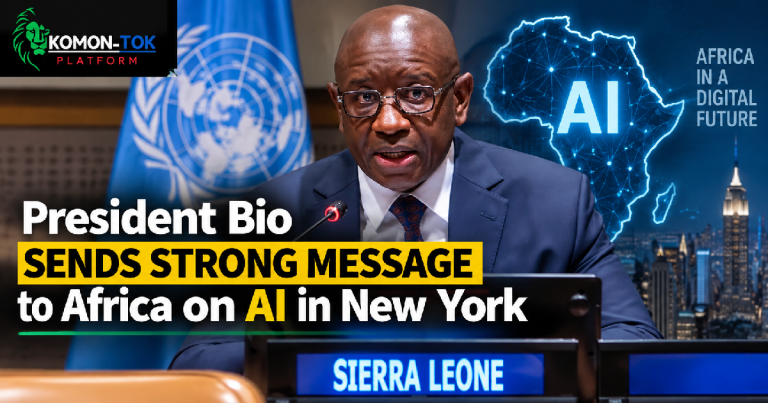
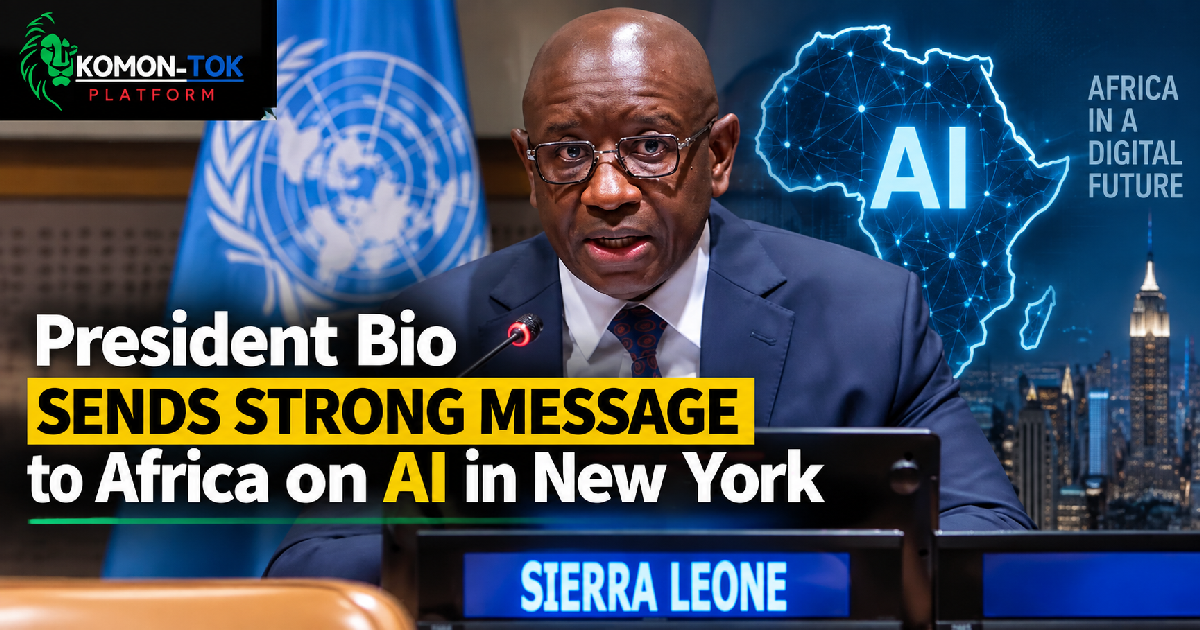
President Dr. Julius Maada Bio has called on Africa to move “from mine to model” in the Artificial Intelligence era, warning that the continent must no longer just supply raw materials but must also own the technology and value created from them.
President Bio made the call on Monday in New York while addressing African Heads of State and Government at a high-level roundtable on AI hosted by Kenyan President William Ruto, on the margins of the 80th UN General Assembly.
According to President Bio, Africa’s minerals will power the data centres that run AI, and African people will generate the data that AI learns from. If Africa is not careful, he warned, it will repeat history – exporting raw data cheaply and importing expensive AI products built with that same data.
“For generations, we have exported raw materials and imported much of the value created from them. We should be careful not to do the same thing with data,” President Bio warned.
He said the goal for Africa should be to move from just being the “mine” that provides the minerals, to becoming the “model” that builds the AI systems.
“Our generation inherited an Africa whose raw materials too often created greater prosperity elsewhere than they did at home. We should not leave the next generation an Africa whose data, knowledge and intelligence do the same,” he said.
President Bio said Africa is home to one-fifth of the world’s population but owns only a fraction of global data centre capacity. While no single African country can build the entire AI ecosystem alone, he said the continent must not accept a future where its infrastructure, models, data and rules are controlled from elsewhere.
He proposed what he called “shared sovereignty” – where African countries build what they can alone, work together where they need scale, protect what is sovereign, and engage the world on terms that reflect African interests.
For Sierra Leone, the President revealed that the country is developing its first National AI Strategy with support from the World Bank, focusing on practical tools that work on mobile phones, in low-bandwidth areas, and in local languages.
He asked: “Can a farmer get better information about his crops? Can a health worker make a better-informed decision? Can a teacher use these tools to help a child learn?”
To solve the infrastructure gap, President Bio also floated the idea of regional “data embassies”, where Sierra Leone could store its critical public data in another trusted African country while still keeping full legal control.
“The principle is simple: sovereignty should travel with the law, not simply with the building,” he said.
He ended by inviting investors, governments and tech companies to Freetown for the inaugural West Africa Integration and Investment Summit (WAIIS) on November 17-18, 2026, where he said the principles discussed in New York will be tested as practice in Freetown.
About The Author