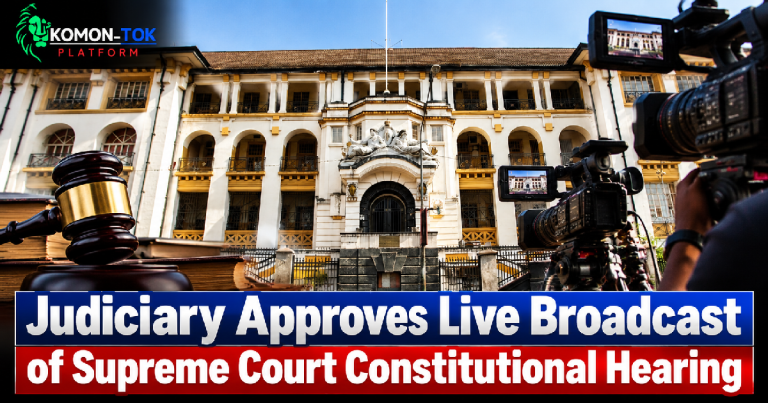
The Judiciary of Sierra Leone has approved live broadcast of the Supreme Court hearing on constitutional amendment matters slated for Tuesday, October 7, 2026, giving the Sierra Leone Association of Journalists (SLAJ) the mandate to coordinate coverage.
In a move the Judiciary described as the first of its kind, Chief Justice Komba Kamanda granted a request from SLAJ for the proceedings to be broadcast live nationwide.
Under the approved arrangement, 10 media houses will be accredited to cover proceedings from inside the courtroom at the Law Courts Building on Siaka Stevens Street. SLAJ will handle accreditation in consultation with the Sierra Leone Court Reporters Association and the Judiciary’s Communications and Public Affairs Unit.
But the public will not need to be inside the court to follow the case.
The Judiciary said major television stations will carry the live feed to offices and homes across the country, while the Independent Radio Network (IRN) will broadcast live through its network of over 40 community radio stations nationwide — from Kailahun to Kambia and Bonthe to Koinadugu.
The approval came after SLAJ wrote to the Chief Justice on September 21, 2026, arguing that the matter is of huge national and constitutional significance and that live coverage would ensure transparency and reduce misinformation.
The Judiciary has allowed live coverage of public interest cases since 2019, including the famous 2019 and 2021 constitutional challenges and commissions of inquiry matters. What is new this time, according to the Judiciary’s Communications Unit, is the direct responsibility given to SLAJ to coordinate.
Conditions have been attached.
Media houses will not be allowed to provide commentary or analysis on the merits or demerits of the case while it remains sub judice, and still photography will not be permitted inside the courtroom. SLAJ has urged all journalists to maintain professionalism, accuracy and respect for the dignity of the Court.
The October 7 hearing is expected to draw massive public interest. The Supreme Court is set to hear arguments on questions surrounding the process to amend the 1991 Constitution, coming at a time when government has been pushing for a review of the constitution through Parliament and public consultations led by the Constitutional Review Committee.
Constitutional lawyers say the case could determine the legal pathway for any future amendment, whether by referendum, parliamentary super-majority, or both, and clarify the limits of executive and legislative powers under Chapter 3 of the 1991 Constitution.
For ordinary Sierra Leoneans, the live broadcast means they can, for the first time, follow constitutional arguments in real time without relying on second-hand reports.