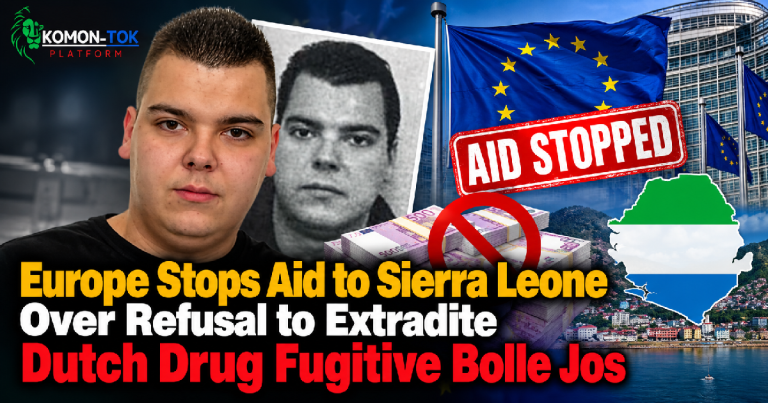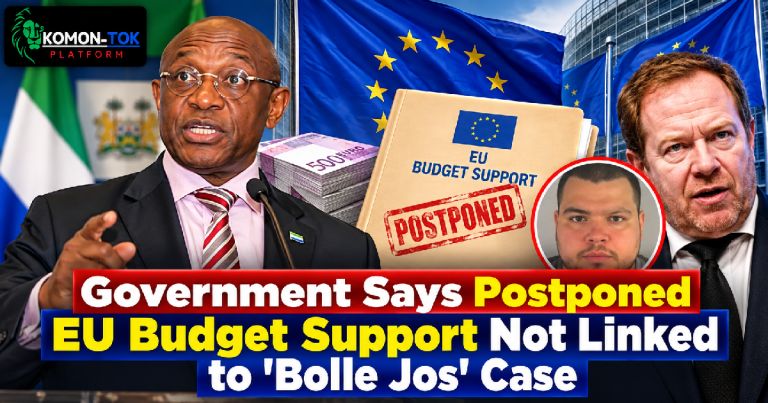
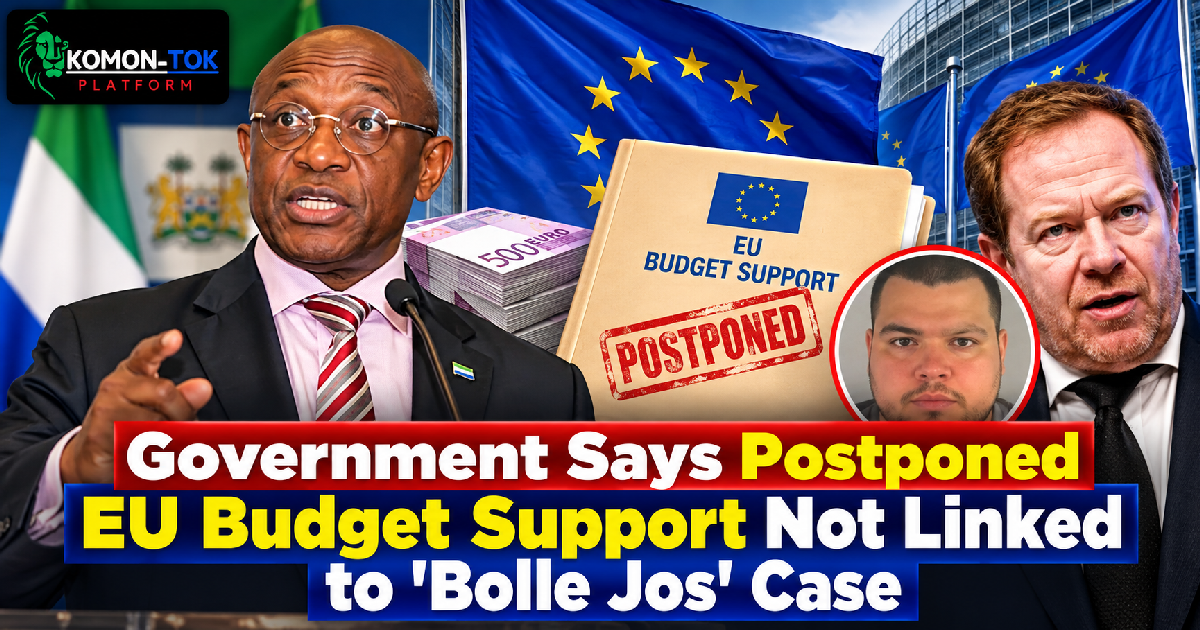
The Government of Sierra Leone says the European Union’s decision to postpone its 2026 budget support payment is not a punishment for the government’s handling of the Dutch fugitive Jos Leijdekkers, alias “Bolle Jos.”
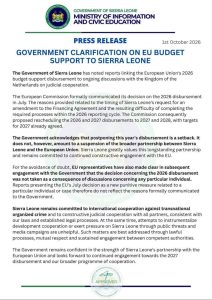
In a Press Release issued today by the Ministry of Information and Civic Education, government moved to clarify growing public speculation that the EU had suspended funds over the ongoing judicial dispute with the Netherlands.
According to the release, the European Commission formally communicated its decision on the 2026 disbursement as far back as July 2026. The reason given at that time, government says, was technical, not political.
The Commission cited “the timing of Sierra Leone’s request for an amendment to the Financing Agreement and the resulting difficulty of completing the required processes within the 2026 reporting cycle.”
It then proposed rescheduling the 2026 and 2027 disbursements to 2027 and 2028, with targets for 2027 already agreed.
“The Government acknowledges that postponing this year’s disbursement is a setback. It does not, however, amount to a suspension of the broader partnership,” the statement reads.
The clarification comes amid intense media coverage linking EU aid to the Jos Leijdekkers case.
Leijdekkers is one of the Netherlands’ most wanted fugitives, convicted in absentia for large-scale cocaine trafficking. He is alleged to have been living in Sierra Leone.
In recent weeks, the Netherlands has been pushing for judicial cooperation and possible extradition. Reports in Dutch and international media claimed the EU was considering withholding budget support to pressure Freetown.
That speculation was fuelled yesterday when it emerged that the European Parliament is preparing to debate and vote on actions against Sierra Leone over its alleged failure to cooperate.
Government today firmly rejected that link.
“For the avoidance of doubt, EU representatives have also made clear in subsequent engagement with the Government that the decision concerning the 2026 disbursement was not taken as a consequence of discussions concerning any particular individual,” the release states.
“Reports presenting the EU’s July decision as a new punitive measure related to a particular individual or case therefore do not reflect the reasons formally communicated to the Government.”
While maintaining its commitment to fight transnational organized crime, government appeared to push back against what it called public pressure.
“Sierra Leone remains committed to international cooperation against transnational organized crime and to constructive judicial cooperation with all partners, consistent with our laws and established legal processes,” the statement says.
“At the same time, attempts to instrumentalize development cooperation or exert pressure on Sierra Leone through public threats and media campaigns are unhelpful. Such matters are best addressed through lawful processes, mutual respect and sustained engagement between competent authorities.”
The Ministry added that Sierra Leone remains confident in its partnership with the EU and looks forward to the 2027 disbursement and broader cooperation programme.
EU budget support is critical direct funding to Sierra Leone’s national budget, usually tied to governance, public financial management, and development targets. Any delay or suspension affects service delivery.
The EU is one of Sierra Leone’s largest development partners, supporting areas from education to agriculture and governance.
Government’s statement today is an attempt to calm fears that the long-standing EU-Sierra Leone partnership is collapsing over a single criminal case, insisting the July decision was procedural and that both payments are now rescheduled to 2027 and 2028.