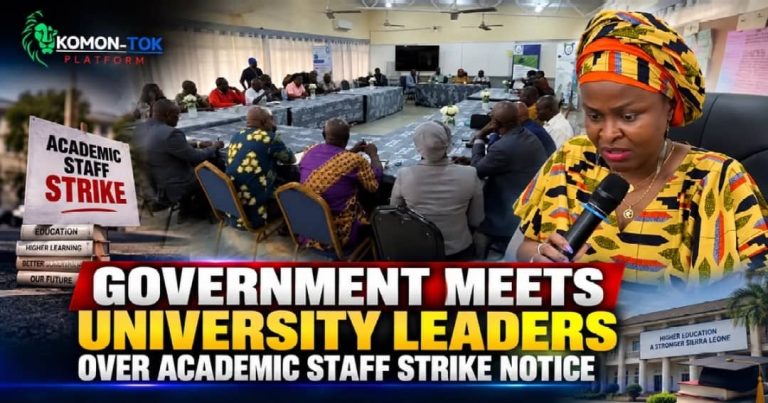
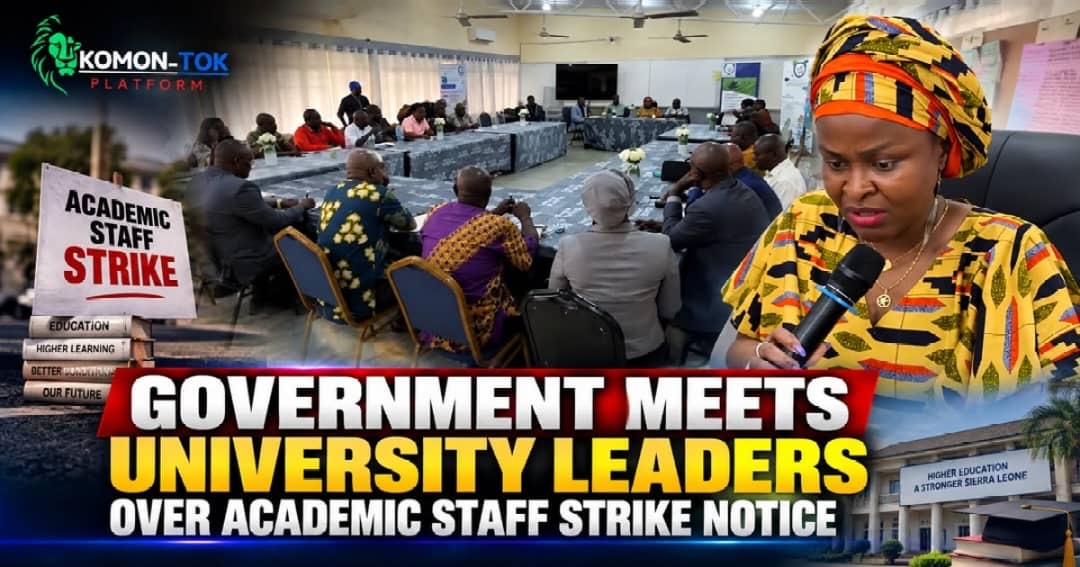
The Government has engaged Chancellors, Vice Chancellors, Principals, Registrars and other senior officials of public tertiary institutions over the industrial action announced by the Union of Academic Staff Association of Public Tertiary institutions, with government officials stressing the need for continued dialogue and adherence to established legal procedures.
The meeting, convened by the Ministry of Technical and Higher Education, brought together representatives from the Wages and Compensation Commission (WCC), the Ministry of Employment, Labour and Social Security, the Sierra Leone Labour Congress and university leadership to review the ongoing negotiations and the implications of the strike notice.
Deputy Minister of Higher and Technical Education, Sarjoh Aziz Kamara, said the meeting was intended to brief university leaders on the government’s engagement with UASA and to discuss measures to ensure the continued functioning of tertiary institutions.
Director of Compensation at the Wages and Compensation Commission, Jeremiah B. Ademokula, said the Commission had conducted a technical assessment of UASA’s salary demands, including their potential impact on the national budget.
He explained that government currently accounts for about 83 percent of salary payments to university staff, while universities cover the remaining 17 percent. The Commission subsequently submitted its assessment to the Ministry of Finance on September 11, 2026, for consideration.
According to him, the next stage requires a joint engagement involving the Ministry of Finance, WCC, the Ministry of Technical and Higher Education and ASA to determine the way forward.
The Chief Executive Officer of the Wages and Compensation Commission, David W. S Banya, said the meeting was also intended to follow up on an earlier letter submitted to the Minister of Finance after a peaceful final engagement at the UCC.
He said the response received through Mr. William had been encouraging, making the subsequent strike notice unexpected. Mr. Banya noted that he had also been engaging Hon. Tingo on the matter and intended to follow up on the earlier correspondence with the Ministry of Finance.
He stressed the importance of maintaining administrative continuity, particularly through acting officials when substantive office holders are unavailable, to avoid delays in the negotiation process.
Deputy Minister of Employment, Labour and Social Security, Hon. Lansana M. Dumbuya, urged the parties to continue using social dialogue and established negotiation mechanisms to resolve the outstanding issues.
He explained that salary negotiations are now handled by the Wages and Compensation Commission, while the Ministry of Employment, Labour and Social Security provides labour administration, oversight and mediation within the established framework.
Hon. Dumbuya stressed that the government recognises the importance of the tertiary education sector and encouraged academic staff to utilise the negotiation process rather than resorting to industrial action while discussions are ongoing.
Secretary of the Sierra Leone Labour Congress, Marx Conteh, acknowledged the growing demand for improved wages and said continued negotiations could help address workers’ concerns and prevent further industrial disruption.
In her statement, Minister of Higher and Technical Education, Dr. Ramatulai Wurie, said the under her leadership, the ministry has consistently engaged UASA and has followed the appropriate institutional and legal processes in addressing its demands.
She explained that UASA presented its proposals on salary increases and conditions of service in June this year. While conditions of service were referred to the respective university councils for consideration and harmonisation, the salary component was referred to the Wages and Compensation Commission, which has the mandate to negotiate salaries.
The Minister said UASA initially proposed a 500 percent salary increase, later reducing the demand to 100 percent, and noted that the government is assessing the proposal against available fiscal resources and relevant benchmarks.
Dr. Wurie also clarified that although university lecturers are employed by their respective university councils, the government has been responsible for paying the majority of their salaries since 2018/2019.
She further said government held engagements with WCC following receipt of the strike notice, but negotiations were still ongoing when ASA announced the industrial action.
The Minister expressed concern over the decision to proceed with industrial action while negotiations were underway, citing Section 64(3) of the Industrial Relations and Trade Union Act 2023 and stressing the importance of following due process.
She reaffirmed the government’s commitment to transparency, dialogue and the rule of law in resolving the outstanding issues.
About The Author