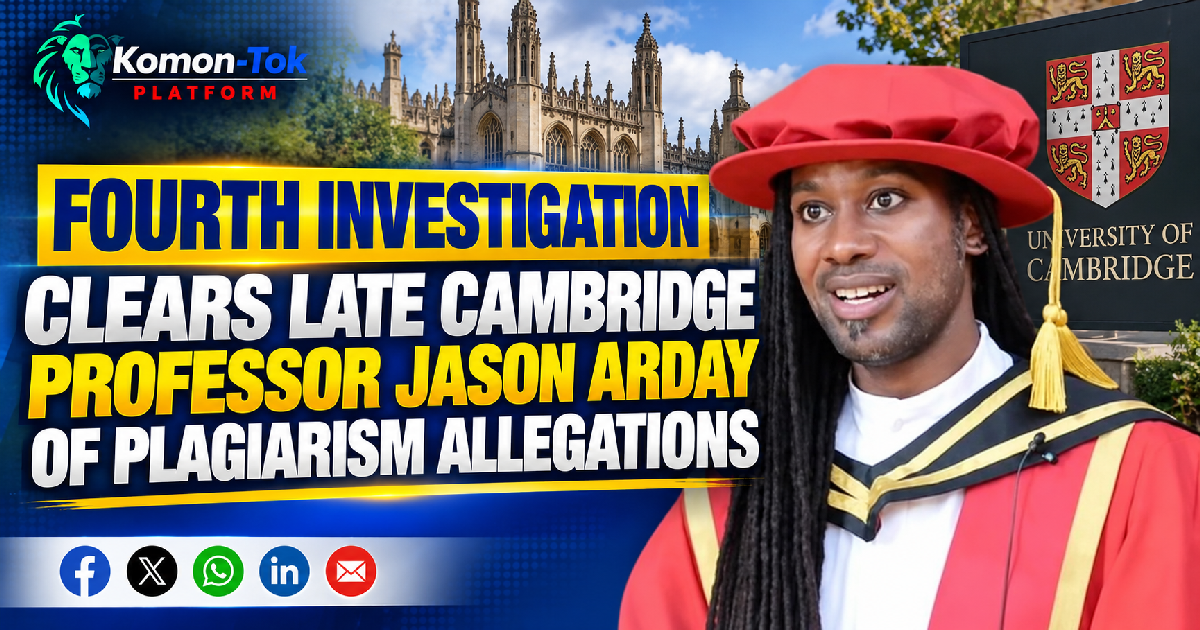
Months after his death, the academic reputation of Professor Jason Arday remains at the centre of a growing controversy over evidence, media coverage and institutional responsibility.
A new investigation by scientific publisher Taylor & Francis has reportedly found no evidence to substantiate plagiarism allegations against Arday, according to reports by Byline Times. The finding is said to be the fourth formal review to conclude without supporting the accusations.
Arday, who became one of the youngest Black professors at the University of Cambridge in 2023, died at his home in London on 14 August 2026, aged 41, nine days after resigning from the university. His death came after weeks of intense public scrutiny.
The controversy began in July 2026 when philosopher Nathan Cofnas accused Arday of significant plagiarism in his PhD thesis and published papers. Arday resigned on 5 August, saying he could no longer cope with the scrutiny.
Four investigations have since been reported:
1. Liverpool John Moores University (PhD thesis): Investigated Arday’s doctoral thesis and did not uphold plagiarism, citing “honest and reasonable error” compounded by inadequate supervision. The university acknowledged severe deficiencies in supervision, reportedly including only one formal structured supervision session during his candidacy.
2. MDPI review (2018 paper): Found correctable citation errors but no plagiarism or fabrication, according to Byline Times. The publisher issued a formal correction rather than a retraction.
3. Taylor & Francis (2020 paper): An earlier review cleared a 2020 paper. The publisher concluded the paper did not meet the threshold for retraction, instead issuing corrigenda inserting missing citations.
4. Taylor & Francis (new review, October 2026): The latest review examined four of his papers and again concluded without finding evidence of wrongdoing, reinforcing the previous findings.
The distinction is important. As noted in reporting on the case, “No evidence to substantiate” is a narrower finding than proof of innocence, and Byline Times itself says it does not rule out the possibility of plagiarism.
Questions are now growing about media accountability. Byline Times reports that several publications have yet to correct claims it considers inaccurate, despite the sequence of clearances.
Meanwhile, the University of Cambridge has shifted the focus of its own review. Initially announced on 7 August to investigate Arday’s appointment, qualifications and honorary positions, the university said in September it would no longer investigate his hiring, and would instead examine its decision-making, support systems and organisational processes during the period of external criticism.
Separately, the Committee for Academic Freedom (CAF), an academic group that has acknowledged funding from billionaire Reform UK donor Ben Delo, has commissioned its own private inquiry into the circumstances surrounding Arday’s appointment to Cambridge in 2023. The review is being chaired by Prof. Swaran Singh and is expected to report within four to six months.
Arday, who has spoken publicly about not speaking until age 11 and not reading until 18, was widely known for his work on race, inequality and education.