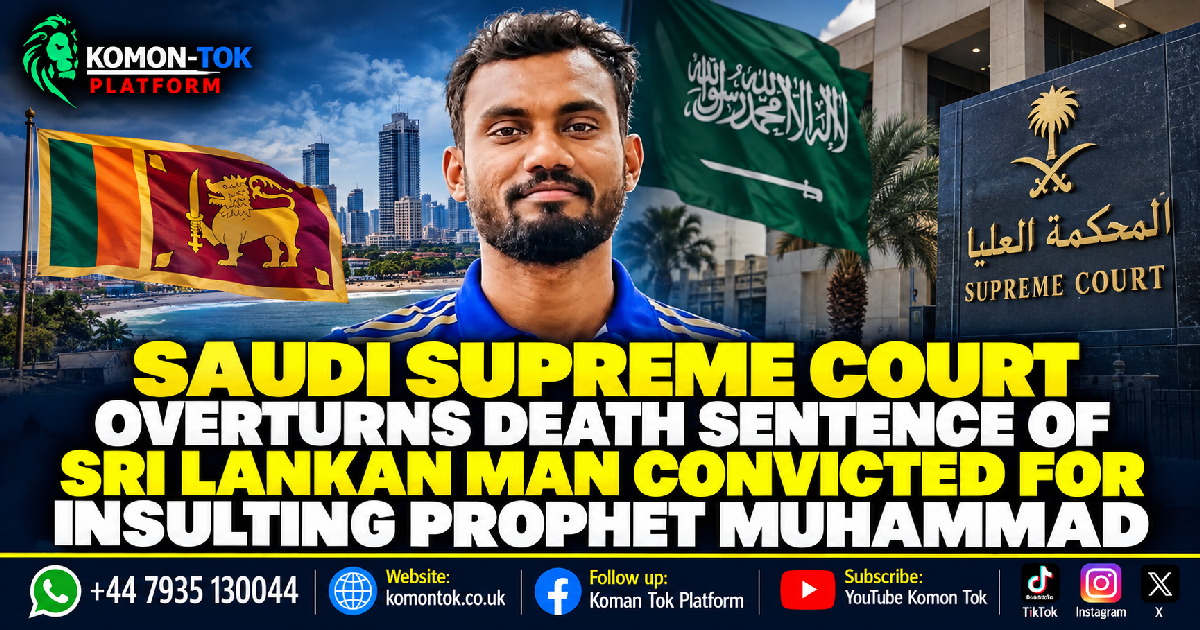
Saudi Arabia’s Supreme Court has overturned the death sentence imposed on a Sri Lankan migrant worker who was condemned to die over a Facebook comment deemed insulting to Islam and the Prophet Muhammad.
The man, Anojan Sivarasa, 27, from Kalmunai in eastern Sri Lanka, had been sentenced to death in September by a Saudi appeals court after being convicted of blasphemy.
Sri Lanka’s Deputy Foreign Minister Arun Hemachandra confirmed the development on Wednesday, saying the Supreme Court set aside the sentence on Tuesday, 13th October. He thanked Saudi authorities and legal teams from both countries for their efforts.
President Anura Kumara Dissanayake welcomed the decision, saying it brings immense relief to Anojan, his family and all Sri Lankans, and reflects the value of patient diplomacy.
How a Facebook Argument Led to Death Row
The case began in late June with a video that went viral in Sri Lanka showing a young Muslim man kicking a dog that had been following Hindu pilgrims. The video triggered heated religious arguments online.
During one exchange, a social media user posted derogatory remarks about a Hindu deity. Sivarasa, who is Hindu, responded in Tamil with comments about the Prophet Muhammad that were later deemed blasphemous by Saudi authorities.
He quickly deleted the comment and posted a video apologising, but screenshots had already circulated. According to the BBC, individuals in Sri Lanka emailed his employer in Saudi Arabia, where he had been working in construction for less than 10 months. His devices were seized and he was arrested in July.
On 15th July, the Al-Ahsa Criminal Court first sentenced him to five years in prison and a fine of 3 million Saudi riyals (about $800,000 / £600,000).
However, on 17th September, the Court of Appeal in the Eastern Region overturned that sentence and imposed the death penalty under Saudi Arabia’s interpretation of Sharia law, which punishes blasphemy with death.
The sentence sparked outrage in Sri Lanka and internationally. Human Rights Watch called it an “outrageous overreaction” and demanded his release, stating “No one should face execution for a comment on religion.”
What Happens Now?
Sivarasa had been held at Dammam Central Prison. Sri Lanka sent a four-member legal team to Riyadh and filed an appeal before the Supreme Court on 11th October. The Sri Lankan Ambassador visited him in prison.
While the death sentence has now been set aside, it is *still unclear whether Sivarasa will be released, will continue to serve a prison term, or will face further legal proceedings*. His family says they have had no direct contact with him since 28th September.
Sri Lankan lawmaker Faizer Mustafa, who is involved in the legal negotiations, confirmed the ruling to BBC Sinhala and said the legal team is now reviewing the Supreme Court’s decision to determine next steps.
The case has renewed focus on the plight of millions of South Asian migrant workers in Gulf states, where strict blasphemy and cybercrime laws can carry capital punishment even for social media posts made in the heat of an argument.