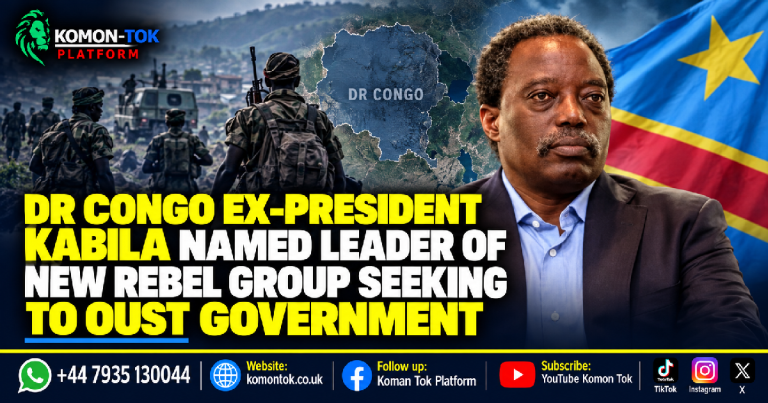
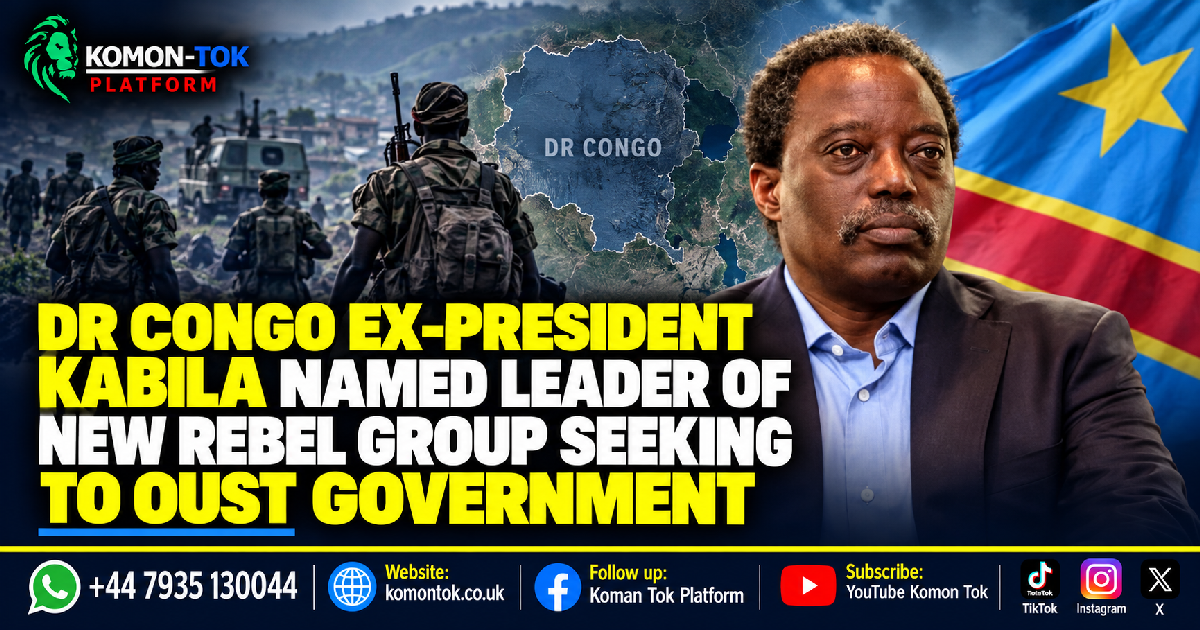
Former Democratic Republic of Congo President Joseph Kabila has been named leader of a new rebel coalition seeking to overthrow President Félix Tshisekedi’s government, in a dramatic escalation of the conflict engulfing the mineral-rich east of the country.
The formation of the Front for the Refoundation of the Nation (FRN) was announced on Monday at a press conference held at Kabila’s residence in Goma, the strategic eastern city that has been under the control of the M23 rebel group since early this year.
According to the BBC, the coalition said it would unite what it described as “resistance forces” to end what it called “tyranny” in Kinshasa, adding that it would pursue its objectives “by all means, including force.”
The announcement is the clearest public confirmation yet of Kabila’s direct involvement in an armed political movement against his successor, nearly a year after he was sentenced to death in absentia by a military court on charges of treason and war crimes. He had previously denied any links to the M23.
M23 military leader Sultani Makenga has been named as one of four deputies in the new structure. The other three deputies are also drawn from the Alliance Fleuve Congo (AFC)-M23 alliance, which seized large swathes of North and South Kivu last year, displacing hundreds of thousands of civilians.
Kabila, 53, ruled DR Congo for 18 years from 2001 to 2019 after succeeding his assassinated father, Laurent-Désiré Kabila. He went into self-imposed exile in 2023, mostly residing in South Africa, before reappearing in Goma earlier this year.
Last week, in a rare address, Kabila promised to outline how Congolese citizens could act to “rescue” the country. On Friday, he accused the Tshisekedi administration of ignoring proposals he said he submitted in 2024 to help resolve the crisis in the east, and charged the government with weakening constitutional rule, mismanaging the economy, and failing to provide security.
The Tshisekedi government has repeatedly accused Kabila of being the political sponsor behind the M23, which the UN says is backed by neighbouring Rwanda – a charge Kigali denies.
The emergence of the FRN adds a new political dimension to a conflict that has destabilised eastern DR Congo for nearly three decades. More than 100 armed groups operate in the region, where violence is fuelled by ethnic tensions, historic political rivalries, and competition over vast reserves of cobalt, coltan, gold and other minerals critical to the global tech industry.
The war has created one of the world’s largest humanitarian crises, with more than 7 million people internally displaced, according to the UN.
The development also comes amid growing uncertainty over DR Congo’s political future. President Tshisekedi’s second and constitutionally final term is due to end in 2028, but in May he suggested that elections scheduled for that year might not be possible due to the ongoing conflict, and indicated he would be open to seeking a third term if supported by the public – a move that would require a constitutional change.
Neither the Congolese government nor the FRN has yet given details on the coalition’s military capabilities or political programme beyond its stated aim of removing Tshisekedi from power.
Regional mediation efforts led by Angola and Kenya have so far failed to produce a lasting ceasefire.