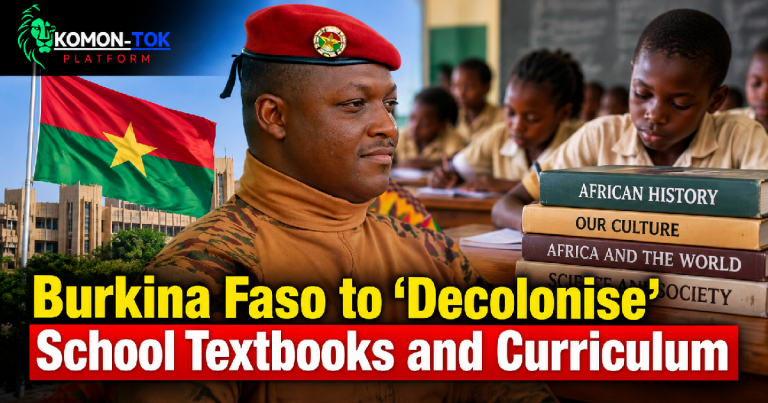
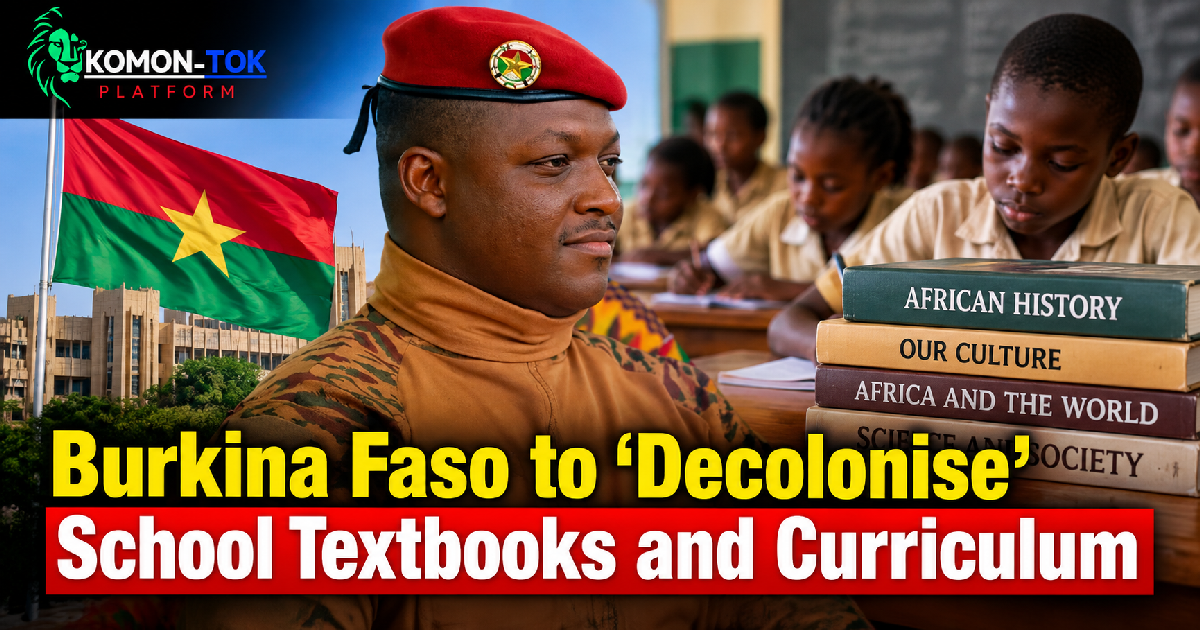
Burkina Faso’s military government says it is overhauling its history, geography and civic education curriculum to “decolonise” what is taught in schools, the latest move by the junta to break cultural ties with former colonial power France.
The reform was announced on Sept. 7 by the Minister of Secondary and Technical Education, Professor Moumouni Zoungrana, for the new 2026-2027 school year.
“We have decided to review these curricula, remove words that treat us like children or animals, and add chapters that promote our values,” Zoungrana said at a government event in Ouagadougou.
“When you open our textbooks, we are portrayed as mere objects. Our victories were never highlighted; on the contrary, the focus was on our defeats and our negative traits,” he said.
School textbooks have not yet been reprinted, but the ministry has distributed an interim guide for teachers specifying language to avoid and chapters to add or remove, according to a history teacher in the capital who spoke to Reuters.
“We will no longer speak of explorers… but of invaders. We will rehabilitate the African resistance fighters who were portrayed as tyrants or barbarians in old textbooks,” the teacher said.
In a longer speech, Zoungrana said: “In our textbooks too there are untruths set down in order to infantilise us, to diminish us… If we want to create a rupture, we shall have to find the courage to break the table completely.” 0307
The booklet reportedly instructs teachers to stop describing Europeans in Africa as “explorers” and “conquerors” and instead describe them as “invaders” and “spies,” and to place greater emphasis on pre-colonial African empires, Burkinabe national heroes and anti-colonial resistance.
Burkina Faso was a French colony as part of French West Africa until independence in 1960 as Upper Volta, later renamed Burkina Faso by revolutionary leader Thomas Sankara in 1984.
Since Captain Ibrahim Traoré seized power in a 2022 coup, the junta has pursued a sovereignty agenda – expelling French troops in 2023, suspending French media, renaming streets that bore French colonial names, and deepening ties with Russia.
It has also formed the Alliance of Sahel States (AES) with fellow military-led neighbours Mali and Niger, a bloc that says it wants political, economic and cultural independence from France and from the West African regional bloc ECOWAS.
Education has become a key part of that agenda. Insecurity linked to Islamist militants has closed thousands of schools in recent years, leaving hundreds of thousands of children out of class. As the government tries to reopen schools, officials say they want to rethink what is taught.
The textbook overhaul fits into a wider continental debate about decolonising education. Critics of the current curricula, which are often adapted from French systems, say they center European perspectives and portray Africans as passive subjects rather than historical actors.
It is not yet clear how quickly new textbooks will be produced, how teachers will be retrained, or whether the changes will affect national exam questions. The ministry has said new chapters will promote “our values” – including patriotism, civic duty and pan-African solidarity – alongside science and technology.
Similar curriculum debates are underway in Mali and Niger, but Burkina Faso is the first AES country to issue formal interim teaching instructions.