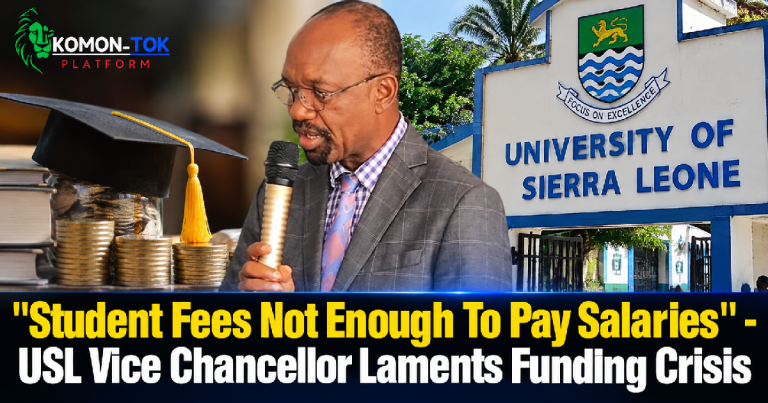
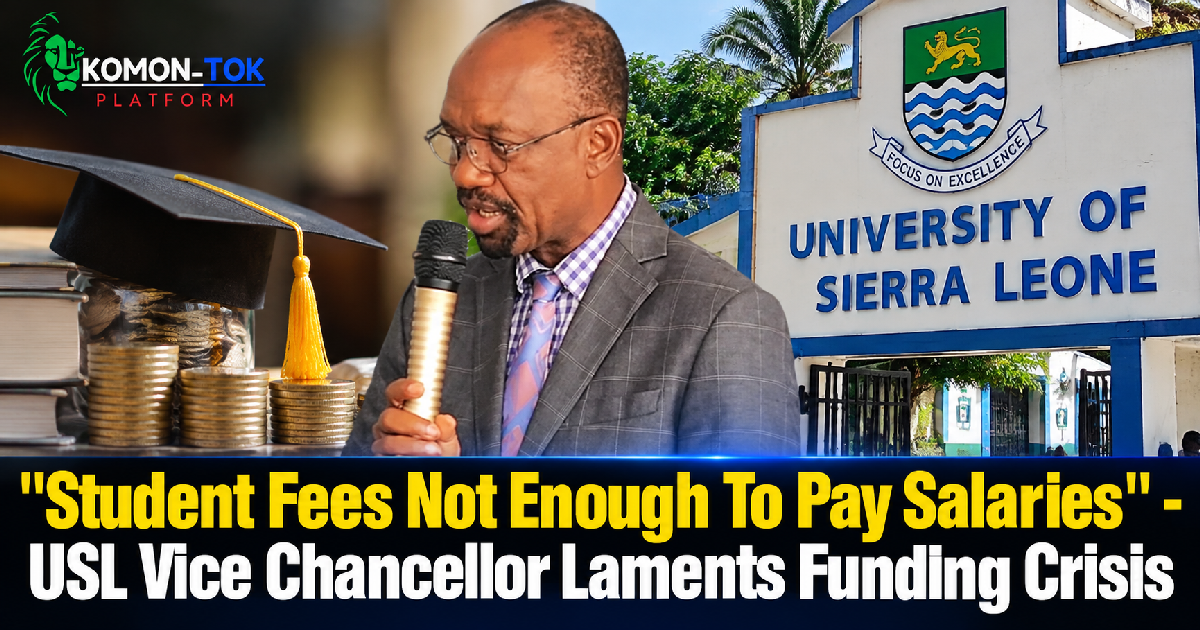
The Vice Chancellor and Principal of the University of Sierra Leone (USL), Prof. Aiah Lebbie, has laid bare the deep financial crisis facing the country’s oldest university, saying money collected from students is not even enough to pay staff salaries.
“As a university, we charge the lowest fee, I must say in the world, except for those who don’t charge fees,” Prof. Lebbie said. “But what you pay is not enough for me to even pay salaries.”
Prof. Lebbie was speaking on Tuesday, 23rd September 2026, at the Institute of Public Administration and Management (IPAM), Tower Hill, during the launch of the IPAM Student and Staff Computer Loan Scheme and the commissioning of an Africell CUG booth and two new digital classrooms.
He disclosed that USL needs about Le 8.5 million every month just to pay its workers, but Government subvention stands at around Le 5 million.
The shortfall of about Le 3.5 million, he explained, has to be covered from students’ fees – money that should have gone into improving learning conditions, digital infrastructure, libraries, research and campus facilities across Fourah Bay College, IPAM and COMAHS.
“That is not what government pays. Government pays something about Le 5 million. If the wage bill is paid, I would be able to do a lot of transformation across the university. But it’s the fees the students pay that I have to repurpose to pay salaries; and so, I am starved of resources to achieve transformation,” he told the gathering.
The VC said the funding gap is the main reason USL is struggling to meet its digital transformation goals, at a time when universities across Africa are moving to smart classrooms, e-learning and AI-driven research.
He appealed to Government to increase subvention, and called on alumni, banks, telecom companies and development partners to support USL.
“Digital transformation in the University of Sierra Leone is not something that we are going to take lightly. And this is why I am asking all the stakeholders to come to our aid and assist us,” he said, urging alumni in particular not to abandon the institution that made them.
The projects commissioned at IPAM – led by ACTB Savings and Loans for the computer loan, and Africell Sierra Leone for the CUG system – are seen as small but important steps to reduce the digital divide among students, many of whom currently rely on their phones or commercial cafés to do assignments and research.
About The Author