
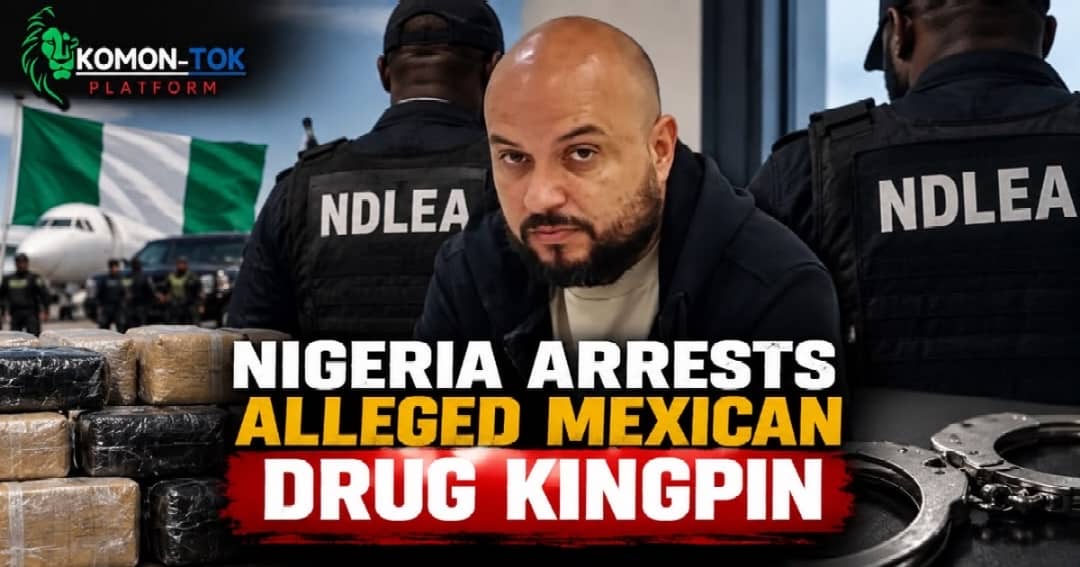
Nigerian authorities have arrested a 40-year-old Mexican national suspected of playing a key role in a transnational methamphetamine production network, after digital photographs and geolocation data on his devices led investigators to a suspected industrial-scale laboratory in the southeast of the country.
Arturo Carrera Loaiza was detained on August 19, 2026, at Lagos’s Murtala Muhammed International Airport while attempting to leave Nigeria, according to the National Drug Law Enforcement Agency (NDLEA).
The agency described him as a “drug kingpin” linked to a wider criminal network involving Mexican nationals and local collaborators. The arrest was publicly detailed this week.
Investigators recovered digital images from Loaiza’s devices showing him wearing a blue laboratory coat next to equipment consistent with methamphetamine production. Location metadata embedded in the photographs directed officers to a property under construction in Isiata Ugoni Okposi, Ebonyi State.
A subsequent raid on August 30 uncovered a temporary structure, chemical odours, and evidence of production activity. CCTV footage recovered from the site allegedly showed a man resembling Loaiza in a lab coat, as well as a Nigerian associate directing the removal of chemicals and equipment around August 21.
Further intelligence led officers to a nearby isolated house where they seized large quantities of precursor chemicals and laboratory equipment. Recovered items included roughly 443 kilograms of acetone, 37 kilograms of toluene, more than 31 kilograms of hydrochloric acid, other solvents and reagents, reaction vessels, condensers, mixers, gas burners, weighing scales, and a sieve bearing traces of methamphetamine.
Loaiza has denied any involvement in drug manufacturing. He told investigators he entered Nigeria on June 10, 2026, alongside another Mexican national, José Ceballos Pérez, after being invited by a Nigerian contact known only as “Henry” to explore a restaurant business venture. Authorities reject that account.
The Ebonyi discovery is the latest in a series of busts. In June 2026, NDLEA operatives dismantled a forest laboratory in Tapa village, Ibarapa North Local Government Area of Oyo State, arresting 56-year-old Mexican national José Villa Ochoa, described as a methamphetamine production specialist, and four Nigerian collaborators. Investigators say Ochoa identified Loaiza as the person who recruited him and facilitated his entry into Nigeria.
A month earlier, in mid-May 2026, the agency raided what it called Nigeria’s largest-ever methamphetamine laboratory, hidden in Abidagba forest in Ogun State. That operation yielded more than 2.4 tonnes of methamphetamine and precursor chemicals valued at roughly $363 million internationally (over ₦480 billion at the time). Three Mexican nationals and several Nigerians were arrested in connection with that site.
In total, Nigerian authorities have uncovered three suspected methamphetamine laboratories linked to Mexican nationals within roughly four months.
NDLEA Chairman Brig. Gen. Mohamed Buba Marwa (retd.) has warned that transnational criminal groups are attempting to establish synthetic drug production facilities in Nigeria’s remote forests and rural areas.
“Nigeria will not be allowed to become a haven for transnational drug cartels seeking to relocate their laboratories from other jurisdictions into our forests and rural communities,” he said.
The cases form part of a broader regional pattern. Mexican cartels, particularly the Sinaloa Cartel and Jalisco New Generation Cartel (CJNG), have increasingly shifted from using West Africa primarily as a trafficking corridor for cocaine bound for Europe toward establishing local production of synthetic drugs such as methamphetamine. Remote locations offer lower operational costs, weaker immediate enforcement pressure in some areas, and proximity to growing African consumer markets as well as export routes. Similar Mexican-linked labs have been dismantled in recent years in South Africa, Kenya, Mozambique and elsewhere on the continent. Experts note that cartels often send experienced “cooks” or chemists to set up operations with local partners rather than exporting finished product from Latin America.
Methamphetamine production involves hazardous precursor chemicals and generates toxic waste, posing environmental and public-health risks in the rural communities where labs are often hidden.
Nigerian authorities say they continue to pursue remaining members of the networks, their financiers and local facilitators.
Loaiza remains in custody pending further investigation and legal proceedings.
About The Author