
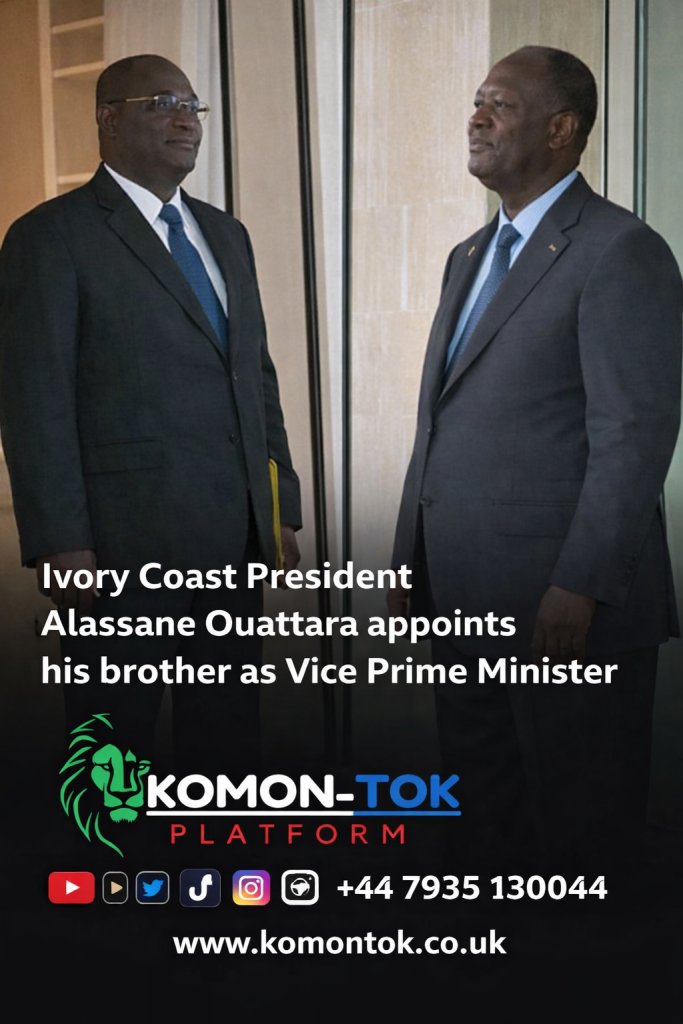
BBC News and other trusted international media outlets report that Ivory Coast President Alassane Ouattara has appointed his younger brother, Téné Birahima Ouattara, as Vice Prime Minister while allowing him to retain the strategically powerful post of Minister of Defence. This appointment has intensified concerns about nepotism, democratic backsliding, and dynastic politics in West Africa.
The decision, announced on 23 January during a minor cabinet reshuffle, comes shortly after President Ouattara secured a fourth term in office with nearly 90 percent of the vote, following elections boycotted by major opposition parties. While the presidency frames the move as a matter of experience and continuity, critics argue it mirrors troubling regional patterns in which long-serving leaders consolidate power within family circles rather than strengthen independent institutions.
Across West and Central Africa, similar dynamics have provoked instability. In Gabon, dynastic succession ended abruptly with a military takeover. In Chad, the transfer of power from father to son drew widespread condemnation and prolonged unrest. Even in Togo, where family rule has persisted for decades, governance credibility remains under constant scrutiny. Observers warn that Ivory Coast risks sliding toward the same trajectory if leadership renewal is managed through kinship rather than democratic accountability.
At 84, President Ouattara has repeatedly promised to prepare the ground for a new generation of leaders. Yet analysts note that concentrating executive authority and national security under one family member directly contradicts that pledge. Control of defence, combined with the vice premiership, places enormous influence in the hands of a single individual, weakening checks and balances and narrowing political space.
Civil society groups caution that such appointments erode public confidence and reinforce perceptions that power in Ivory Coast is increasingly personalised. As the region grapples with coups, constitutional manipulation, and popular disillusionment with political elites, Ivory Coast’s latest reshuffle raises a stark question: is the country strengthening democracy—or quietly normalising dynastic rule?
About The Author