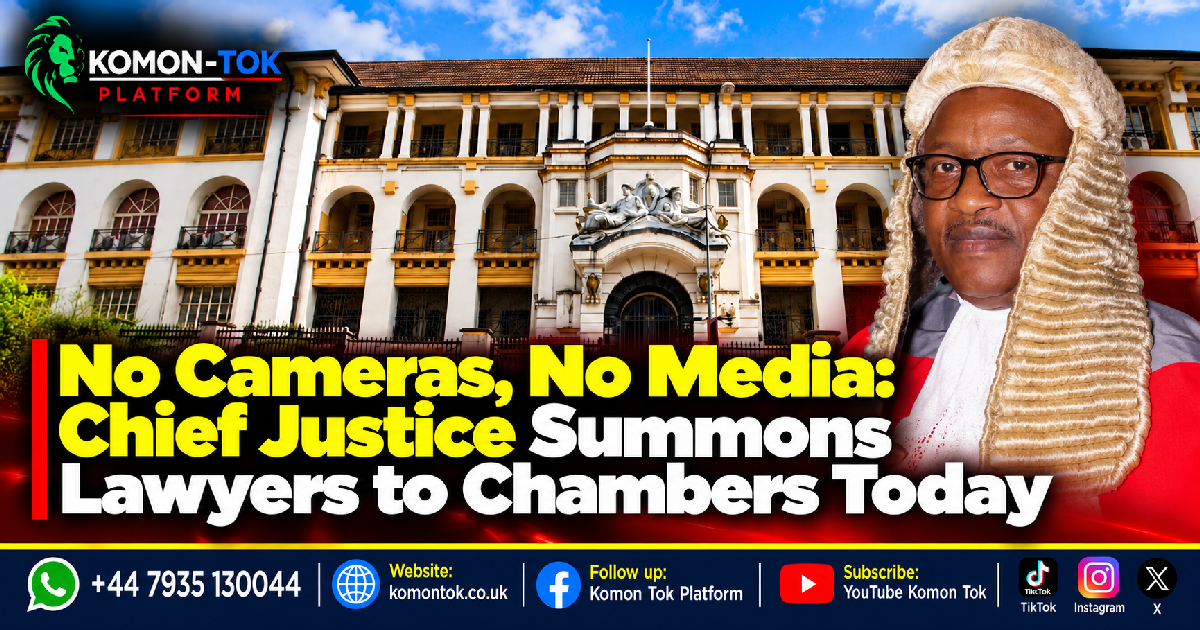
The Chief Justice, His Lordship Justice Komba Kamanda, has summoned all lawyers in the Constitution of Sierra Leone (Amendment) Bill, 2025 cases to appear before him in his private chambers today, Tuesday 20 October.
According to a notice circulated by the Master and Registrar of the Supreme Court, the session will start this morning at the Law Courts Building, Siaka Stevens Street. There will be no live broadcast and the media have not been invited.
This is a sharp departure from what Sierra Leoneans have seen so far. Since August, every major step in these high-profile cases has been broadcast live on SLBC TV, Radio and the Judiciary’s Facebook page – including the 8 October consolidation hearing and the contempt proceedings involving former Attorney-General Joseph Fitzgerald Kamara (JFK). The live coverage attracted tens of thousands of viewers and was praised as a commitment to open justice.
Today, the doors will be closed.
Why the closed-door meeting?
Judiciary sources say the Chief Justice wants to hear the State’s new preliminary objection before setting a timetable for full argument.
Last Thursday, 16 October, the Law Officers’ Department filed a Notice of Motion asking the Court to throw out the three consolidated cases entirely. The motion, supported by an affidavit sworn by Senior State Counsel Joseph Sesay, raises four arguments:
– That Section 94(2) of the Constitution stops any court from enquiring into proceedings in Parliament, including Speaker Segepoh Solomon Thomas’s ruling on 10 August;
– That Section 48(4) grants the President immunity while in office, so the Court cannot make any order that interferes with his power to assent to the Bill;
– That the Bill is not yet law because President Julius Maada Bio has not signed it, so any challenge is premature;
– That Section 127 does not cover this type of challenge.
The State is also asking for a stay – a pause of all written submissions and deadlines – until this objection is decided.
The three cases, filed by opposition MPs, the APC Party, and citizens including Andrew Keili and others, challenge how Parliament handled the Bill on 10 August after APC MPs walked out. They argue that with 149 Members of Parliament, the Constitution requires at least 100 votes (two-thirds of all MPs) to amend the Constitution, but only about 96-97 “yes” votes were recorded.
The Bill would lower the threshold to win the presidency from 55% to 50% plus one, and change how MPs are elected in 2028.
Today’s meeting in chambers is expected to decide two things: whether to grant the State’s request for a pause, and how to handle the jurisdictional objection – whether to hear it alone or together with the main two-thirds argument.
The Judiciary has not yet explained why media were excluded. Lawyers close to the matter say preliminary matters on jurisdiction are sometimes heard in chambers for case management, but acknowledge that for a case of this national importance, public access matters.
All lead counsels, including the Attorney-General, lawyers for the APC, and the Institute for Legal Research and Advocacy for Justice (ILRAJ) – admitted as amicus curiae – have been directed to attend.