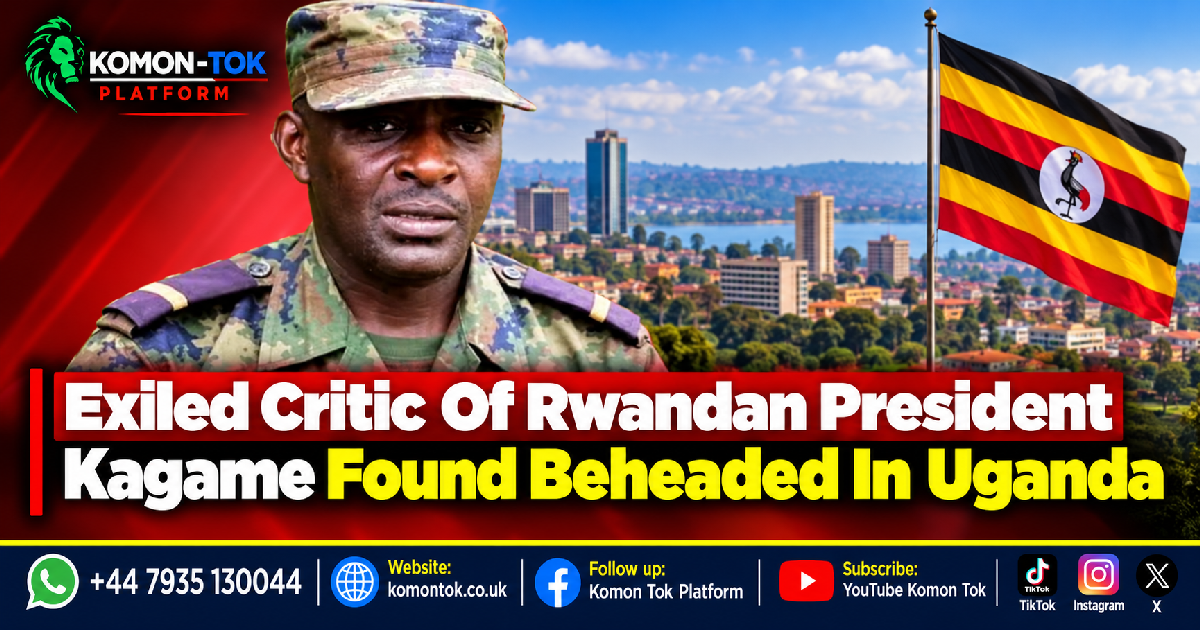
Robert Kabera, a former Rwandan army sergeant major and outspoken critic of President Paul Kagame, has been found beheaded in neighbouring Uganda.
Kabera, 50, fled Rwanda after being accused of sexual assault, which he denied, and sought asylum in Uganda, citing political persecution.
Ugandan police spokesperson, Kituuma Rusoke, said on Monday that Kabera’s head had not been recovered. His body was discovered by local residents on the outskirts of Kampala over the weekend.
“On Saturday, 17 October 2026, Police in Mpigi received a report of murder by cutting,” he said in a post on the Ugandan Police X account on Monday.
“The victim was identified as Mr Robert Kabeera, a 50-year-old, whose head had been decapitated.
“The body was conveyed to the City Mortuary at Mulago, as investigations into the circumstances surrounding the incident have commenced.”
The Rwandan government has not publicly commented on the killing. Several critics of Kagame have been killed both in Rwanda and abroad.
Kabera’s widow, Jeanne d’Arc Rwigema Uwizeye, told BBC Great Lakes in a written message that she feared for the safety of her family.
“It is scary. I feel crazy, the children and I don’t have security,” she said.
According to his family, Kabera had travelled to inspect a construction site about 45 kilometres outside Kampala before his death.
He built a public profile as a musician and YouTuber, attracting more than 144,000 subscribers to his channel, which featured over 800 videos, many of them criticising Kagame and his administration.
Reacting to his death, the opposition Rwanda National Congress (RNC) called for a thorough investigation and urged authorities to bring those responsible to justice.
In a statement on X, the RNC said: “Sgt major Robert Kabera fled Rwanda because he feared for his life. In Uganda, he was building a home—a place where he hoped to find safety and rebuild his future.
“Now Sergeant Major Robert Kabera is dead, brutally killed at the very place where he was building that future.
“musician, and an outspoken critic of Kagame’s government. Years before his death, he publicly described threats and explained why he had sought refuge.
“Today, his family is grieving, his voice is gone, and Rwandans in exile are confronting a terrifying question: where can we be safe?
“His warnings must be examined. His killing must be thoroughly investigated. Those who carried it out—and anyone who ordered it—must face justice.”
“Robert deserved safety. His family deserves answers. His life deserves to be remembered,” it added.
Kabera’s death has renewed concerns about the safety of Rwandan dissidents living in exile.
In 2014, Patrick Karegeya, a former Rwandan intelligence chief who helped establish the RNC, was found dead in his hotel room in Johannesburg, South Africa.
Karegeya fell out with Kagame and was arrested twice, serving an 18-month prison sentence for insubordination and desertion before fleeing to South Africa in 2007, where he became a vocal critic of the Rwandan government.
Following his death, Kagame made remarks widely interpreted as a warning to other critics.
“Any person alive who may be plotting against Rwanda, whoever they are, will pay the price. Whoever it is, it is a matter of time,” he said.
In 2019, South African authorities issued arrest warrants for two Rwandans accused of murdering Karegeya.