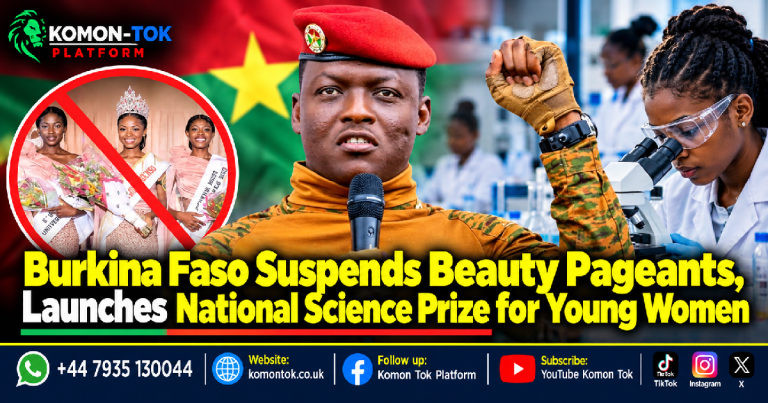
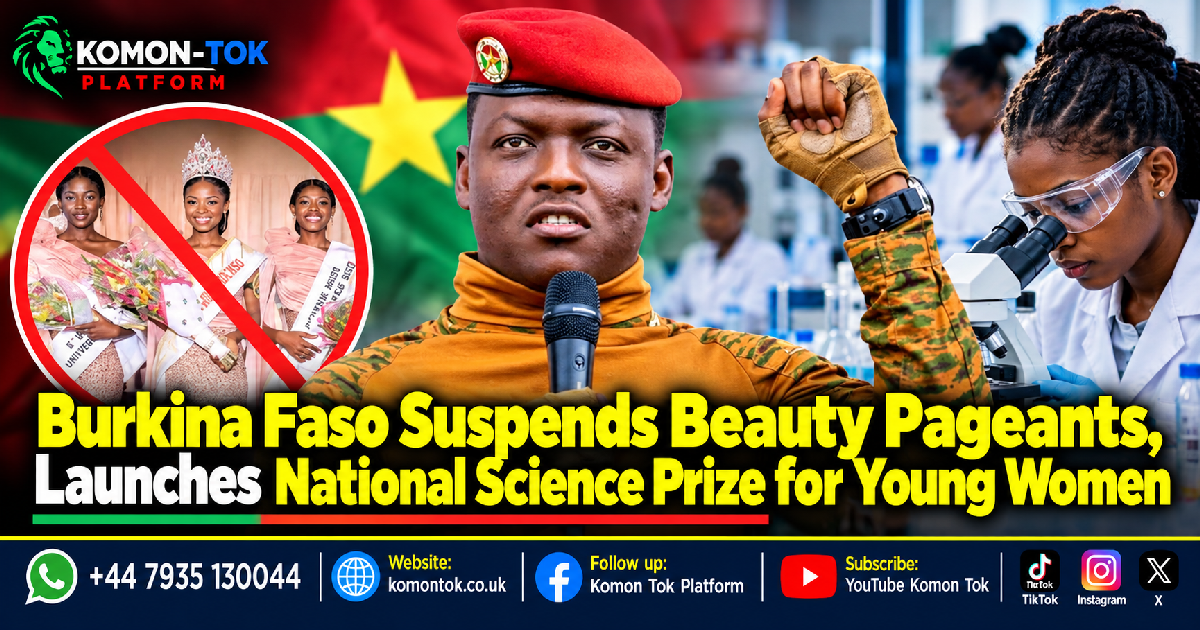
Burkina Faso has temporarily suspended beauty pageants nationwide and is pivoting to celebrate female academic achievement through a new science competition.
On June 8, 2026, the Ministry of Communication, Culture, Arts and Tourism announced that no new permits would be issued for beauty contests pending new regulations. The measure was taken to ensure pageants align with cultural identity, social values and human dignity, according to authorities.
The move is a suspension, not a permanent ban. Culture Minister Pingdwendé Gilbert Ouédraogo has said the contests will return in a redesigned form that promotes local culture, including traditional Faso Dan Fani and Koko Dunda fabrics, African braids and regional heritage.
Two months later, the Presidency launched a separate initiative: HAKILI Mousso.
In Dioula, one of Burkina Faso’s most widely spoken languages, hakili means intelligence and mousso means woman “female intelligence.”
The inaugural edition in August-September 2026 brought together 84 young women from across the country, all of whom had earned a science baccalaureate in 2026. After a week of preparation, they sat for examinations in mathematics, physics and chemistry.
The competition was explicitly designed to challenge the notion that science careers are reserved for men and to encourage more girls into STEM fields.
The top five performers in each subject were awarded prizes. First-place winners received 2 million CFA francs (about $3,400), a motorcycle, a laptop and other rewards, along with scholarships to support their academic journeys.
President Ibrahim Traoré later received the winners at the presidential palace in Ouagadougou, urging them to believe in their abilities, pursue scientific careers and set ambitious goals.
The initiative comes as Burkina Faso, under Traoré’s transitional government since 2022, has pursued a broader agenda emphasizing sovereignty, cultural reassertion, and traditional values. It also comes against a regional backdrop where women remain starkly underrepresented in science — UNESCO estimates women make up less than 30% of researchers in sub-Saharan Africa.
While the government has not officially described HAKILI Mousso as a replacement for pageants, the timing has made the two inseparable in public debate.
Observers note that a competition alone will not close the gender gap. Sustained investment in girls’ education, laboratory infrastructure, mentorship and scholarship programs will be essential to turn recognition into long-term scientific careers.